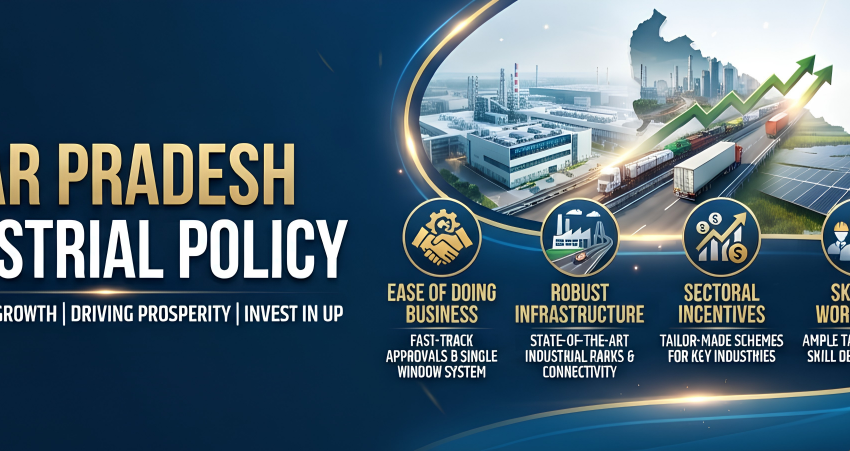
If you’re planning to start or expand a business in Uttar Pradesh, there’s one thing you absolutely need to understand before you sign a single document ie., the UP Industrial Policy. This policy is the reason Uttar Pradesh has quietly become one of the most attractive states in India for entrepreneurs, manufacturers, and investors. It’s not just paperwork, it’s actual money saved, land made easier to get, and approvals that used to take months now happening in weeks.
In this blog, we’ll break down the UP Industrial Policy in the simplest way possible. No jargon, no confusing government language. Just plain facts about what it offers, who can benefit, and how you can use it to your advantage.
What Is the UP Industrial Policy?
The full name of this policy is the Uttar Pradesh Industrial Investment & Employment Promotion Policy 2022, but everyone just calls it the UP Industrial Policy. It was launched by the Uttar Pradesh government with one big, ambitious goal to help turn the state into a US$1 trillion economy by attracting large-scale investment, creating jobs, and making it genuinely easy to set up and run a business here.
Before this policy, many entrepreneurs avoided Uttar Pradesh because of red tape, slow approvals, and unclear incentives. The government recognized this gap and designed a policy that directly tackles these pain points. It rests on five main pillars:
- Investment attractiveness encouraging both Indian and global investors to put money into the state
- Ease of doing business reducing bureaucracy and paperwork
- Marketing “Brand Uttar Pradesh” positioning the state as an investment destination
- Fiscal incentives actual financial benefits like subsidies and tax exemptions
- Sustainability ensuring balanced regional growth and environmentally responsible development
Now let’s get into what actually matters to you : the benefits.
Why Should New Businesses Care About This Policy?
Starting a business anywhere involves cost like land, construction, machinery, taxes, and licenses. The UP Industrial Policy is designed to cut down these costs significantly, especially if you’re setting up a manufacturing unit or an industrial project. Here’s a simple way to think about it: the government is essentially offering to share your setup cost so that more businesses choose Uttar Pradesh over other states.
Let’s look at the actual benefits, one by one.
1. Capital Subsidy – Reducing Your Upfront Investment
One of the biggest incentives under the policy is the Capital Subsidy, which can go up to 42% depending on the size, sector, and location of your project. If your business involves heavy upfront investment, like buying machinery or building a factory. This subsidy directly reduces how much money you need to put in initially.
Businesses get to choose from three subsidy options based on what suits them best:
- Capital Subsidy with additional boosters for specific sectors or regions
- Net SGST Reimbursement (getting back the state’s share of GST paid)
- PLI (Production Linked Incentive) Top-up Subsidy
This flexibility is genuinely useful because not every business benefits the same way from a flat subsidy, some prefer ongoing tax relief instead of a one-time capital boost.
2. Stamp Duty Exemption – A Region-Based Advantage
Buying or leasing land involves paying stamp duty, which can be a significant cost, especially for larger plots. Under the UP Industrial Policy, this stamp duty is exempted based on where you set up your unit:
- 100% exemption in Bundelkhand and Poorvanchal regions
- 75% exemption in Madhyanchal and Paschimanchal regions
- 50% exemption in Gautam Buddh Nagar and Ghaziabad
This means if you’re flexible about location, setting up in a less-developed region like Bundelkhand could save you the entire stamp duty amount, a substantial saving on land acquisition.
3. Easier Access to Land
Land acquisition is usually one of the most frustrating parts of starting an industrial business anywhere in India. The UP government has made this simpler by:
- Creating a dedicated land bank of available government and barren Gram Samaj land
- Leasing this land to industries at just 1% of the circle rate for up to 50 years
- Offering fast-track land allotment for large projects, including 100% FDI-backed companies and Fortune Global 500 companies
- Simplifying land conversion and allotment procedures through single-window processing
For a new business, this means you don’t need to spend months negotiating with private landowners or navigating unclear government land records.
4. Employment-Linked Incentives
If your business is going to generate a good number of jobs, skilled or unskilled, you become eligible for additional benefits under the policy. The government wants industries to hire locally, and it rewards businesses that create meaningful employment with extra financial and policy support. This is particularly relevant for labour-intensive sectors like textiles, food processing, and manufacturing.
5. Infrastructure and Skill Development Support
New businesses often struggle to find a skilled, job-ready workforce. The UP Industrial Policy addresses this by supporting:
- Skill development programs aligned with industry needs
- Infrastructure assistance for setting up in industrial areas
- Development of industrial corridors, training institutes, and Common Facility Centres (CFCs)
This reduces your training costs and ensures you have access to a workforce that’s already somewhat prepared for industrial jobs.
6. Electricity Duty Exemption
Power costs are a recurring, ongoing expense for any manufacturing business. Under this policy, eligible projects can receive an electricity duty exemption, which reduces your operational cost every single month, not just at the time of setup. This is one of those benefits that seems small on paper but adds up significantly over the years.
7. Support for MSMEs – A Separate, Dedicated Policy
If you’re a small or medium business owner and were wondering whether all this applies to you too — yes, it does, but through a slightly different route. The UP government launched a separate policy called the Uttar Pradesh Micro, Small and Medium Enterprises Promotion Policy 2022, specifically designed for MSMEs. This ensures that smaller businesses aren’t left out of the incentive structure that’s mainly built around Large, Mega, Super Mega, and Ultra Mega projects under the main industrial policy.
8. Startups and Innovation Get a Boost Too
The policy isn’t just about factories and manufacturing. It also focuses on:
- Promoting startups across all districts of the state, not just big cities
- Establishing new incubators and accelerators
- Spreading intellectual property (IPR) awareness beyond Tier 1 and Tier 2 cities, right down to rural areas
So if you’re building a tech startup or an innovation-driven business rather than a traditional factory, there’s still a support ecosystem designed for you.
How Does the Approval Process Actually Work?
Here’s where the UP Industrial Policy really stands out compared to how things used to work. The state has built a single-window clearance system called Nivesh Mitra, which lets entrepreneurs apply for and track almost all their approvals – licenses, NOCs, and clearances from one online portal instead of visiting multiple government departments.
The system has evolved significantly:
- Nivesh Mitra 2.0 processed over 22 lakh applications with a 97.3% disposal rate, meaning almost every application actually got resolved, not just filed.
- The state is now rolling out Nivesh Mitra 3.0, an upgraded, AI-powered version that integrates with the National Single Window System (NSWS). This means both state and central government approvals will be available on a single platform, cutting out duplicate paperwork and repeated visits to different departments.
- Nivesh Mitra 3.0 also includes real-time SMS alerts, AI chatbots for instant help, a dynamic Combined Application Form, and GIS-enabled land banks so you can actually see available industrial land visually before applying.
For a new business owner, this translates into faster decisions, fewer delays, and a much more predictable timeline for getting your business up and running.
Who Can Benefit the Most From This Policy?
While almost every industrial and manufacturing business can benefit in some way, the policy is especially rewarding for:
- Manufacturing units setting up Large, Mega, Super Mega, or Ultra Mega projects
- MSMEs, through the dedicated MSME promotion policy
- Companies with 100% FDI or global corporations looking for fast-track approvals
- Businesses willing to set up in less-developed regions like Bundelkhand or Poorvanchal, where incentives are highest
- Startups and innovation-driven businesses in any district of the state
- Labour-intensive industries that generate significant local employment
A Few Things to Keep in Mind Before You Apply
The UP Industrial Policy is generous, but it’s not automatic — you need to apply through the correct channel and meet eligibility conditions for each specific incentive. A few practical tips:
- Register and apply through the Nivesh Mitra portal or get in touch with Invest UP, the state’s official investment promotion agency, for guidance.
- Choose your subsidy option carefully – Capital Subsidy, SGST Reimbursement, or PLI Top-up based on what suits your business model, since you can only pick one.
- Consider your location strategically. Setting up in Bundelkhand or Poorvanchal could mean significantly higher benefits compared to Gautam Buddh Nagar or Ghaziabad.
- Keep your documentation ready in advance, since a faster clearance system still depends on you submitting complete and accurate applications.
Final Thoughts
The UP Industrial Policy is a genuine attempt by the Uttar Pradesh government to make the state one of the easiest and most rewarding places in India to start or grow a business. From capital subsidies and stamp duty exemptions to easier land access and a faster digital approval process through Nivesh Mitra, the policy addresses almost every major pain point that new entrepreneurs usually face.
If you’re seriously considering Uttar Pradesh for your next business venture, this policy is worth studying in detail, not just for the financial savings, but for the sheer convenience it brings to an otherwise complicated process. With Nivesh Mitra 3.0 on the way, things are only set to get faster and more transparent from here.
Disclaimer: Policy details, subsidy percentages, and regional classifications are subject to change based on government notifications. Always verify the latest terms on the official Invest UP website or consult a policy expert before making investment decisions.