
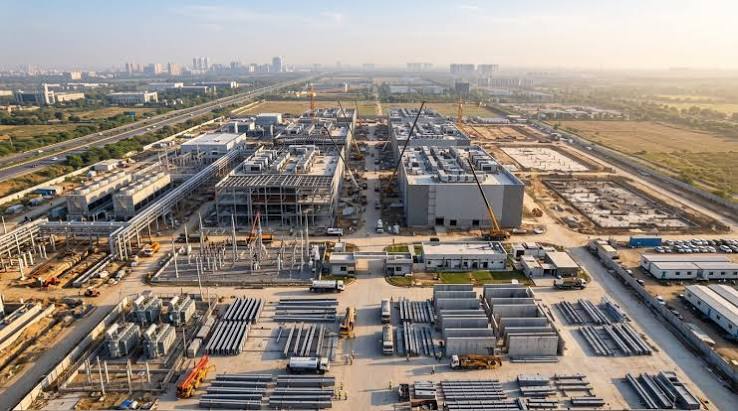
The UP Data Centre Policy 2026 marks one of the most ambitious state-level digital infrastructure initiatives in India. Approved by the Uttar Pradesh Cabinet in July 2026, the policy is designed to transform the state into the country’s largest data centre destination, with a sharp focus on artificial intelligence (AI), cloud computing, and high-performance computing (HPC). If you’re tracking India’s data centre boom, understanding the UP Data Centre Policy 2026 is essential, it signals a shift from generic IT-park incentives to a targeted, AI-first industrial strategy.
In this article, we break down what the policy covers, its investment targets, incentive structure, regional focus, and what it means for investors, job seekers, and the broader digital economy.
What Is the UP Data Centre Policy 2026?
The Uttar Pradesh Data Centre Policy 2026 replaces the earlier 2021 Data Centre Policy, which expired on January 27, 2026. While the previous framework served as an early proof of concept, it managed to mobilise nearly ₹21,000 crore in investments and secure 644 MW of committed capacity over four years,a modest start by today’s standards.
The new policy operates on a fundamentally larger scale. It targets more than ₹2 lakh crore in fresh investment and 2 gigawatts (GW) of additional data centre capacity across the state, positioning Uttar Pradesh as a serious contender in India’s rapidly expanding digital infrastructure race. Some industry estimates put the total private investment ambition even higher, at upwards of ₹4.9 trillion once the full ecosystem, including allied AI and deep-tech ventures is factored in.
Under Chief Minister Yogi Adityanath’s leadership, the policy reinforces the state’s broader vision of becoming a key contributor to India’s digital economy and the national goal of achieving a $1 trillion state economy.
Why This Policy Matters for India’s AI Economy
Unlike the 2021 version, which focused mainly on attracting general-purpose data centres, the 2026 policy is explicitly built around the compute demands of the AI era. It introduces dedicated incentives for GPU-based data centres and energy-efficient facilities, reflecting the surge in demand for compute infrastructure needed for AI model training, inference, and other data-intensive enterprise workloads.
This AI-first approach is reinforced by a related provision often referred to as the AI Compute Booster, a special incentive category for data centres that align with AI modelling and deep-tech startup ecosystems, offering enhanced support on top of standard subsidies.
PRAGATI: Building the Compute Ecosystem Around Data Centres
A standout feature of the policy is its attempt to integrate data centres with a wider deep-tech ecosystem rather than treating them as standalone real estate projects. The state has earmarked 75 acres for a project called PRAGATI (Park for Robotics, AI, GPU Clusters and Advanced Technical Innovation) in Noida, alongside ₹100 crore set aside for specialised hubs focused on quantum computing and semiconductor design.
The idea is straightforward: by building compute-hungry AI and robotics research clusters alongside data centre parks, the state creates built-in demand for the very infrastructure the policy is trying to attract. Officials have also directed these hubs to prioritise commercialising research rather than limiting activity to academic study alone.
Investment, Capacity, and Job Creation Targets
The headline numbers of the UP Data Centre Policy 2026 are significant:
- Investment target: Over ₹2 lakh crore in private investment
- Capacity target: 2 GW of additional data centre capacity
- Direct employment: Approximately 7,500 direct long-term jobs
- Temporary employment: Around 50,000 temporary jobs during construction and development phases
- Indirect employment: Additional indirect job opportunities are expected as IT and IT-enabled industries grow around emerging data centre clusters
Under the earlier 2021 policy, six data centre parks and two standalone data centre units were approved, involving roughly ₹21,343 crore in investment, with seven projects already operational. The 2026 policy builds directly on this base while significantly raising the ceiling on ambition.
Key Incentives Under the UP Data Centre Policy 2026
The policy retains and expands several incentive mechanisms first introduced in 2021, while adding new AI-specific provisions. Based on the state’s approach so far, incentives are expected to include:
- Capital subsidy for large projects, covering a share of fixed capital investment
- Interest subsidy on loans taken for setting up data centre parks and units
- Land allotment concessions, including special discounts on land allocation
- Stamp duty exemption, with relief of up to 100% on qualifying transactions
- Electricity duty exemptions, offering long-term relief on power-related levies
- AI Compute Booster incentives for GPU-heavy and AI-aligned facilities
Regional Incentives: Bundelkhand and Purvanchal Get a Bigger Push
One of the more talked-about provisions in the UP Data Centre Policy 2026 is its attempt to correct regional imbalance in industrial development. Companies setting up data centres in Bundelkhand and Purvanchal will receive a land subsidy covering 50% of land cost, compared with 25% elsewhere in the state.
This isn’t a new idea. The same 50% land subsidy existed under the 2021 policy but failed to attract a single data centre to either region in four years. Critics argue that investment in regions like Bundelkhand and Purvanchal has historically followed infrastructure development, such as expressways, rather than land subsidies alone. For instance, the Gorakhpur Industrial Development Authority attracted over ₹11,600 crore across nearly 500 units in the eight years after 2017, compared to just ₹29 crore across two units in the previous five years, a shift that coincided with new expressway connectivity rather than incentive changes.
That said, the state appears to be pairing incentives with actual groundwork this time. By early 2026, Bundelkhand had already acquired more than 24,000 acres about two-thirds of the land needed for its first development phase along with early anchor projects.
Data Governance Under the New Policy
Beyond attracting private investment, the UP Data Centre Policy 2026 also addresses public-sector data infrastructure. The policy proposes securely integrating data across various state government departments through a State Data Center Authority. Alongside the data centre policy, the Cabinet also approved a separate data policy for the Electronics Department, aimed at strengthening departmental data management.
This dual approach ie., private investment incentives plus public data governance reform reflects a broader attempt to modernise both the commercial and administrative sides of Uttar Pradesh’s digital ecosystem simultaneously.
How the 2026 Policy Compares to the 2021 Policy
Investment mobilised/targeted: ₹21,000 crore (2021) vs. ₹2 lakh crore+ targeted (2026) Capacity: 644 MW committed (2021) vs. 2 GW+ targeted (2026) AI/GPU focus: Limited (2021) vs. Dedicated GPU and AI Compute Booster incentives (2026) Regional incentives: 50% land subsidy in Bundelkhand/Purvanchal (2021) vs. Retained, paired with active land acquisition (2026) Ecosystem integration: Standalone data centre parks (2021) vs. Linked with PRAGATI, deep-tech hubs, startup policy (2026) Data governance: Not a core focus (2021) vs. State Data Center Authority proposed (2026)
What This Means for Investors and Job Seekers
For data centre operators, cloud providers, and AI infrastructure companies, the UP Data Centre Policy 2026 offers a clear set of financial incentives, expedited land access, and a growing compute ecosystem to plug into particularly around Noida and the NCR belt. Companies considering GPU-heavy or AI-training facilities stand to benefit most from the newer, AI-specific incentive layers.
For job seekers, the policy’s emphasis on both construction-phase employment and longer-term technical roles suggests opportunities across multiple skill levels from infrastructure and construction work to specialised data centre operations, AI engineering, and semiconductor-adjacent roles tied to the PRAGATI initiative.
For policy watchers, the real test will be whether Bundelkhand and Purvanchal can convert incentives into actual investment this time around, given the mixed track record of similar subsidies under the 2021 policy.
Final Thoughts
The UP Data Centre Policy 2026 represents a clear evolution in how Uttar Pradesh approaches digital infrastructure moving from broad IT-park incentives to a focused strategy built around AI compute, GPU infrastructure, and integrated deep-tech ecosystems. With ambitious targets of ₹2 lakh crore in investment, 2 GW of new capacity, and tens of thousands of jobs, the policy positions the state as a serious player in India’s data centre and AI infrastructure landscape.
Whether these targets are met will depend heavily on execution, particularly around power availability, land acquisition, and whether regional incentives finally succeed in drawing investment to Bundelkhand and Purvanchal. For now, the UP Data Centre Policy 2026 stands as one of the most significant state-level bets on India’s AI-driven digital future.