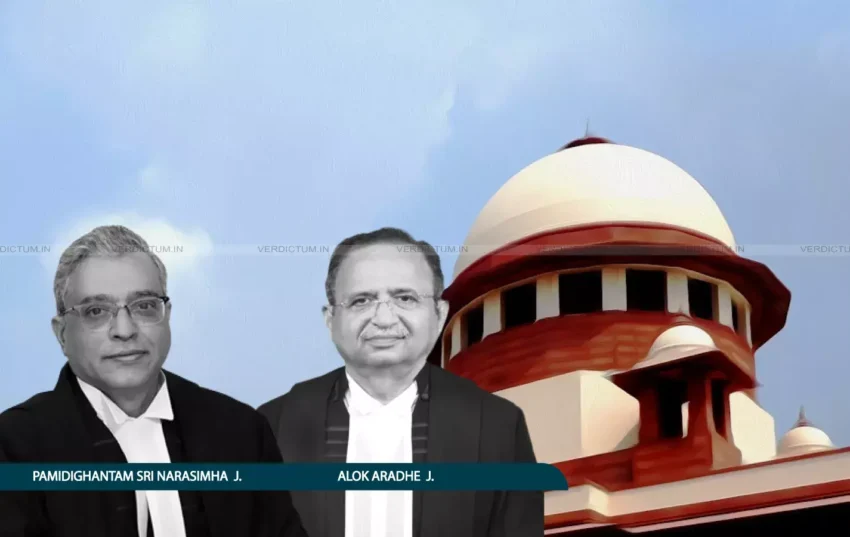
The Supreme Court Gaursons judgment, delivered on November 17, 2026, brings an end to a long-running dispute between the Uttar Pradesh Avas Evam Vikas Parishad (UP Housing Board) and real estate developer Gaursons India Pvt. Ltd. A bench of Justice PS Narasimha and Justice Alok Aradhe dismissed the appeals filed by the UP government and the Housing Board, upholding an Allahabad High Court order that had quashed a ₹388 crore demand against the developer. Here is a simple breakdown of the facts, the arguments and the Court’s reasoning.
What Is the Supreme Court Gaursons Judgment?
The case is titled Uttar Pradesh Avas Evam Vikas Parishad & Anr. v M/s Gaursons India Pvt. Ltd. & Ors. The Supreme Court upheld the High Court’s decision to set aside two things: a June 2022 order of the Uttar Pradesh Chief Secretary, to the extent of its conditions on pricing and land use, and the September 2022 demand notice that followed it.
In short:
- Who appealed: The UP government and the UP Housing Board
- Who won: Gaursons India Pvt. Ltd.
- Amount in dispute: ₹388 crore
- Court below: Allahabad High Court, whose order was upheld
- Bench: Justice PS Narasimha and Justice Alok Aradhe
- Reported as: 2026 LiveLaw (SC) 1174
Background: How the Dispute Began
The story goes back to land owned by Gaursons’ predecessors, which the Housing Board acquired for its Vasundhara Scheme in Ghaziabad.
- 1995: The Supreme Court disposed of an earlier appeal on a compromise. The acquired land (12.047 acres) would be adjusted within the scheme, and no party would pay any value or compensation for the exchange.
- 2004: Under an Exchange Deed, two parcels in Arthala village (Khasra Nos. 948 and 1454) were allotted to the predecessors as alternative land. Gaursons bought them in 2005.
- The problem: The land had already been taken back by the District Magistrate in 1994 for a bird sanctuary, so it could not actually be used.
- 2016: After years of litigation, the Housing Board signed a second Exchange Deed giving Gaursons alternative land in the Siddharth Vihar Yojana.
- Development: Gaursons paid ₹32.45 crore as land conversion charges and built 2,476 general houses and 450 EWS/LIG houses, which were sold to homebuyers.
- 2022: Following a PIL and a Special Investigation Team (SIT) report, the Chief Secretary directed that the land be allotted at the current bulk sale rate. The Housing Board then issued the ₹388 crore demand notice.
- 2023: The Allahabad High Court set aside two conditions of the order and the demand notice, and the State appealed to the Supreme Court.
What the UP Government and Housing Board Argued
Appearing for the State, Attorney General R Venkataramani and Additional Solicitor General Aishwarya Bhati were joined by Senior Advocate PN Misra for the Housing Board. Their main points were:
- The 1995 order and Clause 4 of the 2004 Exchange Deed limited the land to water purification-related use, yet the 2005 sale deed described it as residential.
- The 2016 Exchange Deed was signed without regard to those restrictions.
- The SIT’s findings pointed to collusion between Housing Board officials and Gaursons.
Gaursons’ Defence
Gaursons argued that the Housing Board had kept and commercially used the originally acquired land in the older, higher-value Vasundhara Scheme without paying any compensation. In that situation, it said, the Board could not treat the 2016 deed as a fresh commercial allotment and charge the bulk sale rate. It also pointed to the ₹32.45 crore already paid as conversion charges.
Why the Supreme Court Rejected the ₹388 Crore Demand
The Court went through the 1995 compromise and both exchange deeds before reaching its conclusions:
- No perpetual restriction: The words “said land” in the 1995 compromise referred to the originally acquired land, not to whatever parcel the Board later gave in exchange. The compromise did not attach a permanent use restriction to replacement land.
- Failure of due diligence: The Board allotted parcels that had already been resumed for a bird sanctuary and were recorded as lake and banjar land. The predecessors, through no fault of their own, could not take possession.
- 2004 deed failed: Because of this, the 2004 Exchange Deed did not survive, and its Clause 4 use restriction did not bind Gaursons. The High Court was right to set aside the condition that tried to bring the restriction back.
- Right to transfer: A person with title has the right to transfer property. The 2005 sale deed also assigned the right to receive any other land given in lieu, so the later land vested in Gaursons.
- 2016 deed stands apart: The Court described it as a fresh registered instrument, signed with the State Government’s no-objection, covering a different plot in a different scheme. It was a residential freehold plot that allowed residential construction, and it carried over only the term that no value is payable.
- No basis for the bulk sale rate: Considering Clause 13 of the 2016 deed, the lower circle rates in Siddharth Vihar and the ₹32.45 crore already paid, the Court saw no ground for the Board to demand more. It also noted that the Board had retained and developed more valuable acquired land without paying compensation.
On the collusion allegations, the Court noted that Gaursons had objected to the SIT’s constitution and report. The appeals were dismissed with parties bearing their own costs.
Impact on Homebuyers: Time Extended for EWS/LIG Flats
The Court also extended by three months, from the date of its judgment, the time given by the High Court to the State of Uttar Pradesh for allotting the 450 EWS/LIG flats. Along with the 2,476 general houses already built, this brings clarity to a project where homebuyers had been caught in the middle of a long dispute.
What the Judgment Means for Developers and Public Authorities
- Authorities must do their homework: Giving land that is already encumbered or reserved for another use can come back against the allotting body.
- Exchange deeds are read closely: Courts look at what each deed actually says, and later deeds are not automatically bound by restrictions in earlier ones.
- Compensation matters: An authority that keeps and uses acquired land without paying for it may struggle to demand extra payment for replacement land.
- Certainty for projects: The ruling offers relief to buyers and developers in similar land-exchange disputes, though each case depends on its own documents.
Frequently Asked Questions
What did the Supreme Court decide in the Gaursons case? It dismissed the appeals of the UP government and Housing Board and upheld the Allahabad High Court’s order quashing the ₹388 crore demand.
Who heard the case? A bench of Justice PS Narasimha and Justice Alok Aradhe.
Why was the ₹388 crore demand rejected? The Court found that the Housing Board failed to exercise due diligence in the original allotment and had kept the acquired land without compensation, so it could not demand a further price for the substituted land.
What happens to the EWS/LIG flats? The State has been given three more months from the date of the judgment to allot the 450 EWS/LIG flats.
Was the SIT report accepted? The Court noted that Gaursons had objected to the SIT and its report, and dismissed the State’s appeals.
Conclusion
The Supreme Court Gaursons judgment is a reminder that public authorities are held to the terms of their own agreements and must act with care when allotting land. By upholding the High Court, the Court closed the door on the ₹388 crore demand and cleared the way for the pending allotment of EWS/LIG flats. Developers, homebuyers and housing authorities will be watching how this reasoning is applied in future land-exchange disputes.
Disclaimer: This article is for general information only and is not legal advice. It is based on media reports of the judgment as of November 2026. Please refer to the full order for the exact findings and directions.